

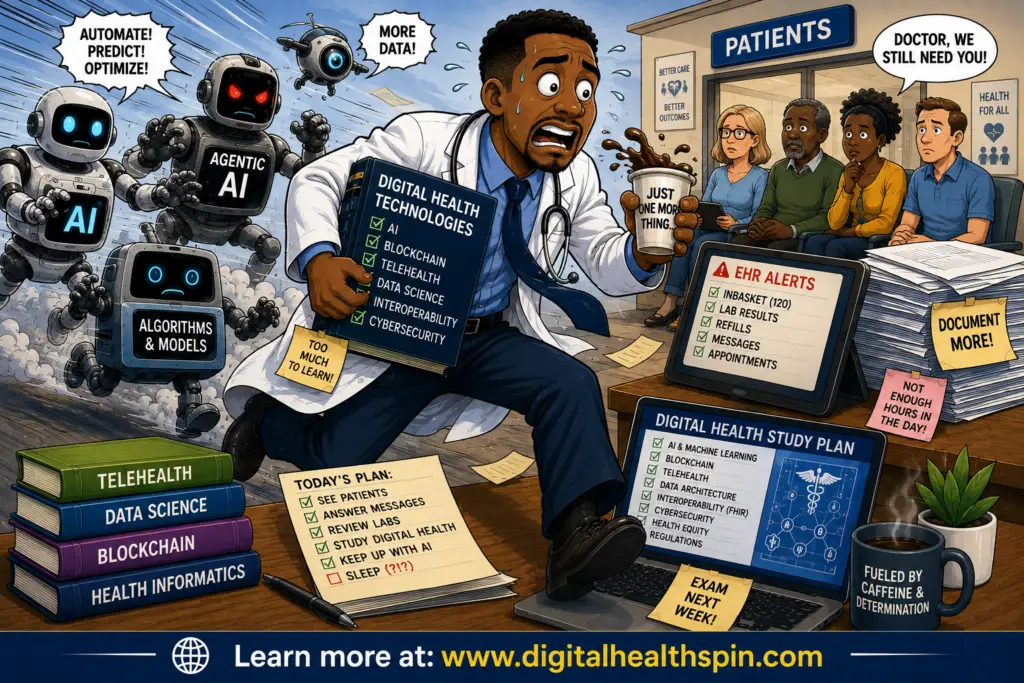
Why Every Physician Needs Digital Health Literacy Now
From Sushi delivered by an app to your doorstep, to finding a soulmate via a dating-app swipe, rapid technology has defined daily life since the dot-com boom of the early 1990s.
Healthcare, naturally, got the memo about a decade late and is still arguing about the font on the fax cover sheet.
This digital health revolution was jump-started by the shift to electronic health records (EHRs) under the “Obamacare” mandate, which also set off today’s health data explosion (Blumenthal, 2010). Inefficiency, waste, and opacity make healthcare fertile ground for disruption — but the biggest driver is simpler: patients now expect to be treated like consumers.
They already bank, date, and monitor their pets remotely from their phones; naturally, they want the same from their doctor’s office, minus the awkward small talk.
If you’re reading this, you already sense that healthcare’s slow-moving resistance to tech is fading.
Patients will keep pulling for convenience, and institutions will keep pushing digital tools to compete. This guide gives you a methodology — not just a list — for vetting any introductory digital health course, physician to physician.
What Makes a Digital Health Course Actually Worth Your Time
Curriculum content was our top yardstick. We also weighed CME/CE credit availability, self-paced flexibility, and cost. To mirror how a real clinician searches, we pulled the top search-engine results for “introductory digital health courses for physicians” rather than hand-picking niche options.
The 12-Topic Curriculum Checklist for a Balanced Course
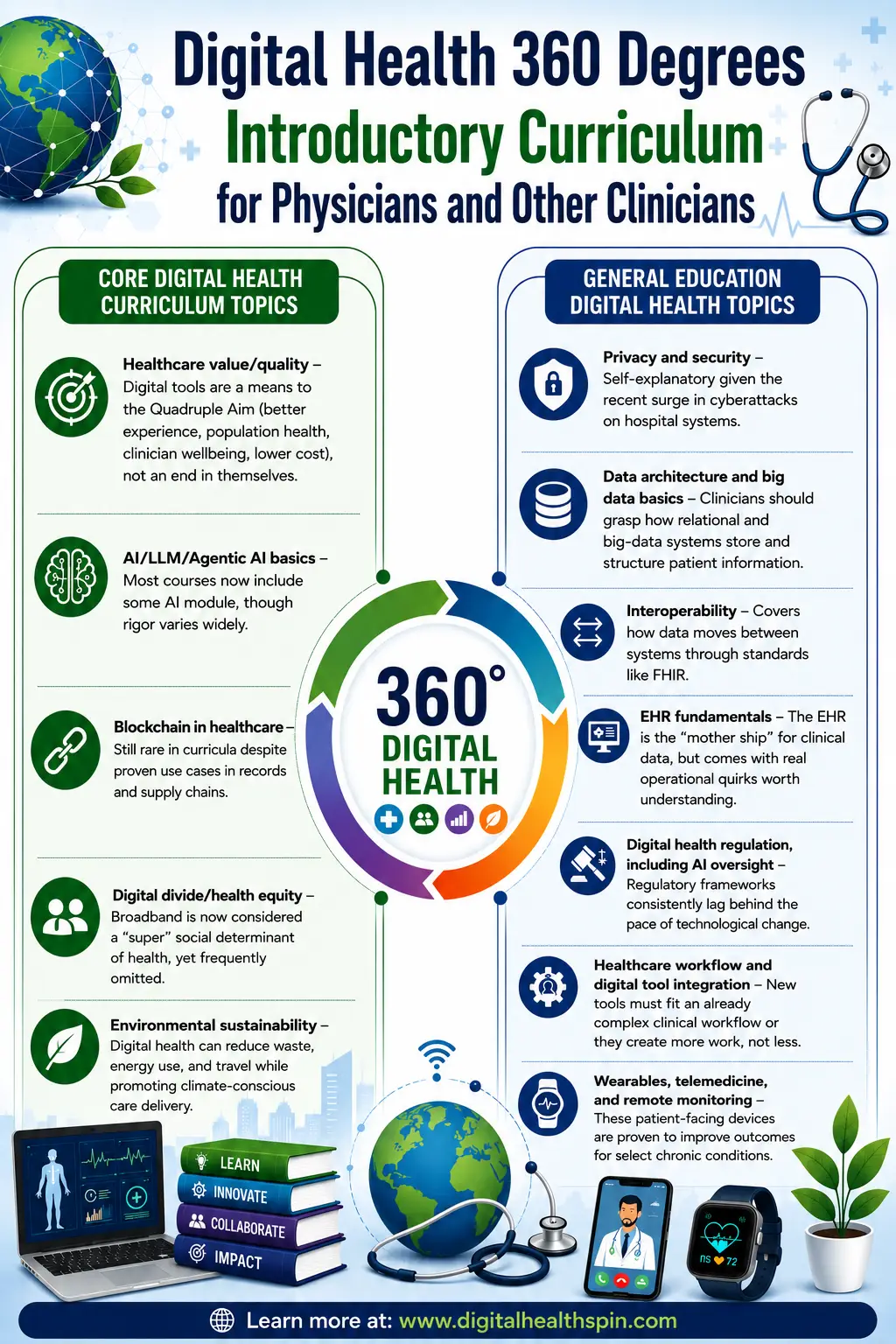
We identified 5 core and 7 general topics. An excellent course should cover at least 3 of 5 core topics and 6 of 7 general topics — none of the popular courses we reviewed hit that bar.
Core topics:
- Healthcare value/quality — digital tools are a means to the Quadruple Aim (better experience, population health, clinician wellbeing, lower cost), not an end in themselves (Bodenheimer & Sinsky, 2014).
- AI/LLM/Agentic AI basics — most courses now include some AI module, though rigor varies widely (Bedi et al., 2025).
- Blockchain in healthcare — still rare in curricula despite proven use cases in records and supply chains (Abu-Elezz et al., 2021).
- Digital divide/health equity — broadband is now considered a “super” social determinant of health, yet frequently omitted (Ferretti et al., 2021).
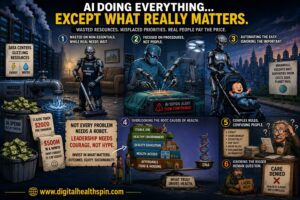
- Environmental sustainability — data centers carry a real carbon and water cost that’s almost never taught (Purohit et al., 2022).
General topics:
- Privacy and security — self-explanatory given the recent surge in cyberattacks on hospital systems (Offner, K. L., et al 2020).
- Data architecture and big data basics — clinicians should grasp how relational and big-data systems store and structure patient information (El Aboudi & Benhlima, 2018).
- Interoperability — covers how data moves between systems through standards like FHIR (Vorisek et al., 2022).
- EHR fundamentals — the EHR is the “mother ship” for clinical data, but comes with real operational quirks worth understanding (Blumenthal, 2010).
- Digital health regulation, including AI oversight — regulatory frameworks consistently lag behind the pace of technological change (Gerke et al., 2020).
- Healthcare workflow and digital tool integration — new tools must fit an already complex clinical workflow or they create more work, not less (Eikey et al., 2019).
- Wearables, telemedicine, and remote monitoring —these patient-facing devices are proven to improve outcomes for select chronic conditions (Noah et al., 2018).
How the Popular Online Digital Health Courses Stack Up
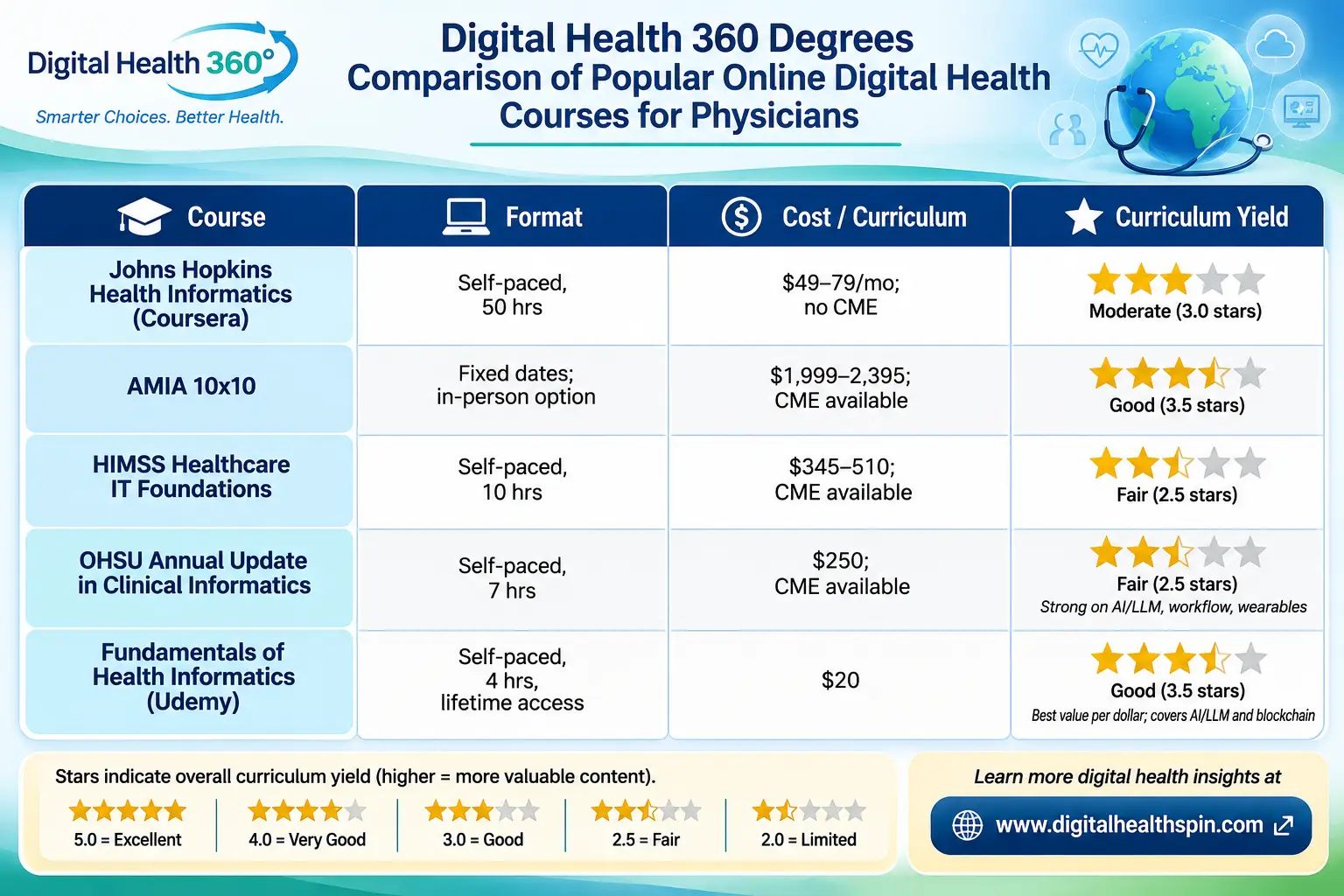
Our Verdict: Digital health 360 degrees lens
Despite the World health organization (WHO) recognizing digital/internet access as a social determinant of health, many digital health curricula are still deficient in adding digital divide/digital health equity as a core topic/module.
Ahmed-Digital Doc Tweet
None of these courses alone deliver a fully balanced curriculum. Environmental sustainability and blockchain are the biggest blind spots industry-wide; digital divide is only ever partially addressed.
Our Digital health 360 degrees suggested curriculum topics above will make for a well-balanced understanding of the concept of digital health enough to navigate the technological “invasion” of our day without getting overwhelmed.
This suggested curriculum is meant for beginners who are not well versed in digital health.
Our advice: combine two or more courses — the Udemy course and AMIA 10×10 pair especially well — to reach true competency. There are likely stronger, less SEO-visible courses out there too; use our 12-topic checklist to evaluate anything we didn’t cover here.
Need a hand building your own curriculum? I’m offering free help to the first 20 physicians who email ahmed@digitalhealthspin.com with the subject “course curriculum assistance.” Trust me, I’m a doctor (in Dr. Dre’s voice). 😉
In Good Health,
The Digital Health 360° Framework™
Your guide to health innovation through:
- Clinical Value
• Health Equity
• Economic Sustainability
• Environmental Sustainability
References:
- Abu-Elezz, I., Hassan, A., Nazeemudeen, A., Househ, M., & Abd-Alrazaq, A. (2021). The benefits and threats of blockchain technology in healthcare: A scoping review. International Journal of Medical Informatics, 142, 104246. https://doi.org/10.1016/j.ijmedinf.2020.104246
- Bedi, S., Liu, Y., Orr-Ewing, L., et al. (2025). Testing and evaluation of health care applications of large language models: A systematic review. JAMA, 333(4), 319–328. https://doi.org/10.1001/jama.2024.21700
- Blumenthal, D. (2010). Launching HITECH. New England Journal of Medicine, 362(5), 382–385. https://doi.org/10.1056/NEJMp0912825
- Bodenheimer, T., & Sinsky, C. (2014). From triple to quadruple aim: Care of the patient requires care of the provider. Annals of Family Medicine, 12(6), 573–576. https://doi.org/10.1370/afm.1713
- Eikey, E. V., Chen, Y., & Zheng, K. (2019). Unintended adverse consequences of health IT implementation: Workflow issues and their cascading effects. In Cognitive Informatics (Springer).
- El Aboudi, N., & Benhlima, L. (2018). Big data management for healthcare systems: Architecture, requirements, and implementation. Advances in Bioinformatics, 2018, 4059018. https://doi.org/10.1155/2018/4059018
- Ferretti, A., Segantin, A., & Vayena, E. (2021). Digital inclusion as a social determinant of health. npj Digital Medicine, 4, 52. https://doi.org/10.1038/s41746-021-00413-8
- Gerke, S., Babic, B., Evgeniou, T., & Cohen, I. G. (2020). The need for a system view to regulate artificial intelligence/machine learning-based software as medical device. npj Digital Medicine, 3, 53. https://doi.org/10.1038/s41746-020-0262-2
- Noah, B., Keller, M. S., Mosadeghi, S., et al. (2018). Impact of remote patient monitoring on clinical outcomes: An updated meta-analysis of randomized controlled trials. npj Digital Medicine, 1, 20172. https://doi.org/10.1038/s41746-017-0002-4
- Offner, K. L., Sitnikova, E., Joiner, K., & MacIntyre, C. R. (2020). Towards understanding cybersecurity capability in Australian healthcare organisations: A systematic review. Journal of Asian Public Policy, 15(2), 1–19. https://doi.org/10.1080/17516234.2020.1801353
- Cyber-Attacks on Hospital Systems: A Narrative Review — ScienceDirect
- Purohit, S., Neve, R. D., Sundaramoorthy, K., et al. (2022). Assessing the carbon footprint of digital health interventions: A scoping review. Journal of the American Medical Informatics Association, 29(12), 2128–2139. https://doi.org/10.1093/jamia/ocac196
- Vorisek, C. N., Lehne, M., Klopfenstein, S. A. I., et al. (2022). Fast Healthcare Interoperability Resources (FHIR) for interoperability in health research: Systematic review. JMIR Medical Informatics, 10(7), e35724. https://doi.org/10.2196/35724
Courses reviewed:
- Johns Hopkins Health Informatics Specialization. Coursera.
- AMIA 10×10 Course. American Medical Informatics Association.
- HIMSS Healthcare Information and Technology Foundations. HIMSS.
- OHSU Annual Update in Clinical Informatics. Oregon Health & Science University.
- Fundamentals of Health Informatics. Udemy.