

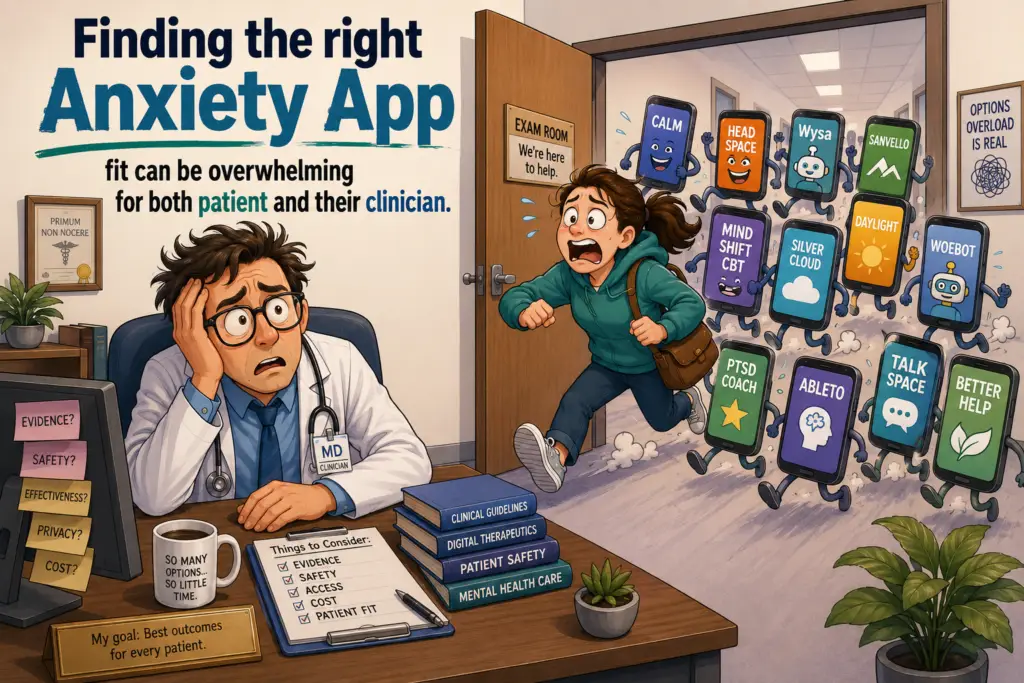
The Mental Healthcare Access Crisis: Why Apps Have Entered the Chat
Anxiety disorders are among the most prevalent mental health conditions in the United States. An estimated 19.1% of U.S. adults experienced an anxiety disorder in the past year, and roughly 31% will be affected at some point in their lives (NIMH, 2023).
These conditions — spanning generalized anxiety disorder (GAD), social phobia, panic disorder, and PTSD — carry consequences well beyond psychological distress, including significantly elevated cardiovascular disease risk (Garcia et al., 2023).
Most anxiety apps are best suited as adjunctive tools for stable patients — not standalone treatments for acute or severe anxiety disorders."
Ahmed-Digital Doc Tweet
Our Evaluation Framework: The Digital Health 360° Methodology
This guide evaluates leading anxiety apps across three critical dimensions for healthcare professionals, patients, and digital health vendors:
- Evidence-based efficacy — Clinical validation and effectiveness
- Quality and safety — Data privacy, cybersecurity, and harm prevention
- Socio-ethical factors — Cost, environmental sustainability/memory usage, accessibility, and multilingual support
How Anxiety Apps Are Classified: What You Need to Know Before Downloading
1. Regulatory Status
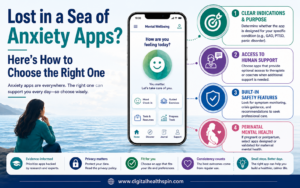
FDA-cleared prescription digital therapeutics (PDTs) versus unregulated consumer wellness apps. DaylightRx is currently the only FDA-cleared app specifically indicated for GAD, requiring a licensed provider’s order (Big Health, 2025). Meru Health carries a broader label covering anxiety, depression, stress, and burnout.
2. Therapeutic Technique
Evidence-based methods include cognitive behavioral therapy (CBT), dialectical behavior therapy (DBT), mindfulness/meditation, and heart rate variability (HRV) biofeedback.
3. Delivery Method
AI-powered chatbots, structured exercise modules, or gamification — often combined. Like choosing a gym, success depends less on which is objectively “best” and more on which one you will actually keep showing up to.
4. Clinical Indications
Single-condition apps (e.g., DaylightRx for GAD) versus multi-condition platforms (e.g., Meru Health, BetterHelp).
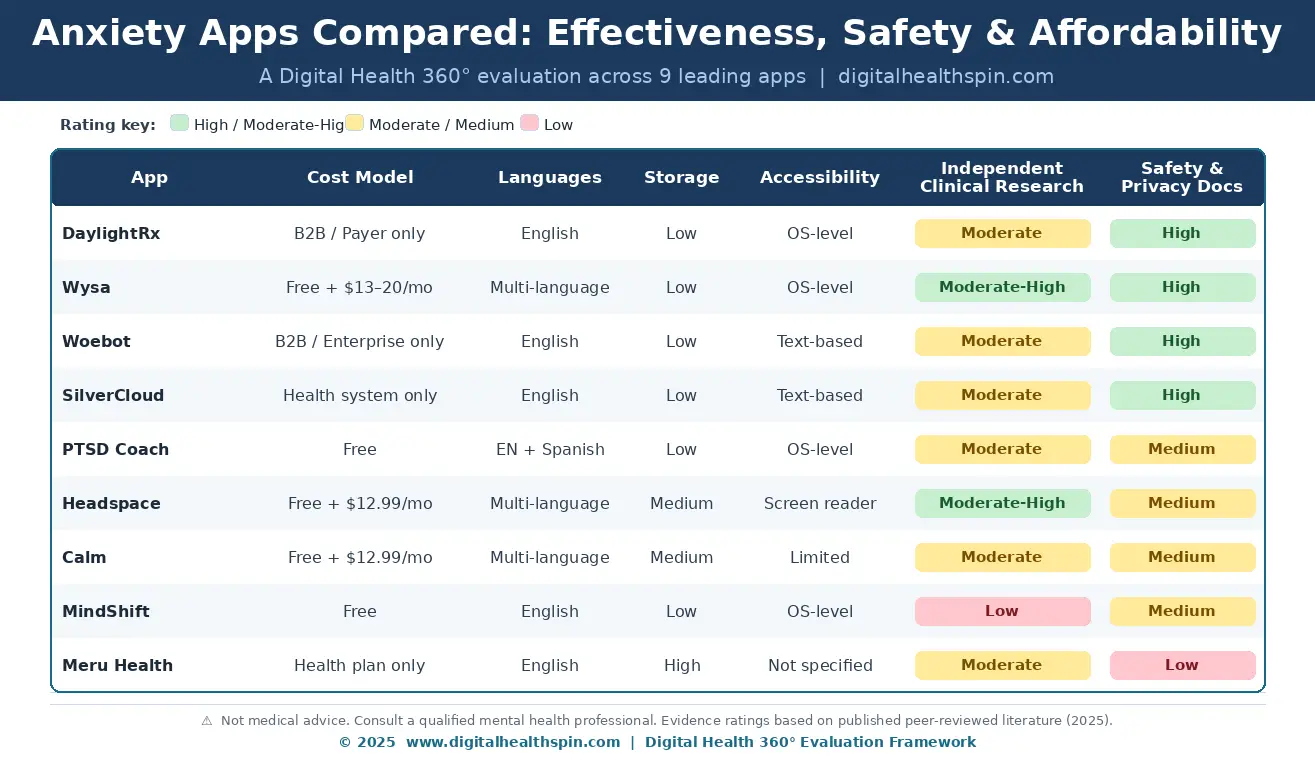
Comparative Effectiveness: Which Anxiety Apps Have the Clinical Evidence and worth your Time and Data?
FDA-Cleared Apps as a Medical Device
DaylightRx is a prescription-only App that has gone through the rigors of FDA approval as a medical device. It has published randomized control trials (RCT) evidence demonstrating over 70% GAD remission rates at 10 weeks (Carl, 2020; Darden, 2024). These trials were developer-sponsored — a conflict-of-interest limitation shared across the industry.
Non-FDA cleared APPs as Medical Device
Wysa leads the non-FDA-approved tier with more than 20 clinical trials, four of which were independently conducted (MacNaeill, 2024; Leo, 2022). It also holds FDA Breakthrough Device Designation, granting it expedited review eligibility (Wysa, 2024).
Headspace has 14 RCTs, with 50% independently conducted — the highest proportion of independent trials in this review (Zawadzki, 2025; O’Daffer et al., 2022). Up to 40% demonstrate anxiety/stress reduction and up to 75% show effectiveness for depressive symptoms.
Calm has five RCTs supporting effectiveness for anxiety, depression, stress, and insomnia, two of which were independently conducted.
Woebot has published evidence in perinatal mental health and substance use; however, none of the reviewed trials were independently conducted (Woebot Health, 2021). It has discontinued its direct-to-consumer app, now operating exclusively through B2B and clinical partnerships.
SilverCloud, Sanvello, and PTSD Coach (VA/DoD) each have supporting RCT evidence, though all SilverCloud and most Sanvello trials were developer-sponsored.
PTSD Coach’s five published RCTs — all DoD-sponsored — showed consistent PTSD symptom improvement.
"High download numbers signal popularity — not effectiveness. The best anxiety app is the one clinically matched to your diagnosis, not your algorithm."
Ahmed-Digital Doc Tweet
How do Anxiety Apps compare based on Clinical Safety, Privacy, and Cybersecurity (Who Is Protecting Your Data?)
Highest Grade: Daylight, Wysa, Woebot, and SilverCloud have clear, user-friendly privacy policies with explicit third-party disclosures, declared encryption standards, and documented rights to permanent data deletion (Big Health, 2025; SilverCloud, 2025; Woebot Health, 2026).
Daylight explicitly states that App is not for emergencies and not a crisis hotline as a limitation of the App. Silvercloud also has similar safety warning emphasizing that their platform is not a replacement for human therapist but rather a guided wellness App for GAD.
Wysa made it clear that its not a replacement for face to face therapy and not for severe conditions of crisis and suicidality.
Woebot has inbuilt mechanism to detect repeated “concerning” language for escalation of care beyond the App.
Moderate Grade: Headspace and Calm disclose data collection practices but do not list specific third parties. Calm’s encryption is confirmed only via independent Mozilla review rather than the app’s own policy (Mozilla, 2023; Calm, 2024).
Lower Grade: Meru Health’s privacy policy reads like a HIPAA compliance document written by a legal team who has never spoken to an actual user — technically present, practically impenetrable, with no mention of third-party data recipients or the right to permanent deletion (Meru Health, 2025).
An important safety caveat: emerging evidence suggests that AI chatbot therapists, given their large language model tendency to agree with users, may cause harm in certain clinical contexts (Linardon et al., 2025).
Emerging evidence suggests that AI chatbot therapists, given their large language model tendency to agree with users, may cause harm in certain clinical contexts.
Ahmed-Digital Doc Tweet
Anxiety Apps Compared: Affordability, Multilingual Support, and Accessibility — Who Gets Left Behind?
Choosing an anxiety app is not purely a clinical decision — it is also a socio-ethical one. Cost, language availability, storage requirements, and accessibility features collectively determine whether these tools are genuinely inclusive or accessible only to those already well-resourced. For this comparison, apps requiring under 100MB are classified as low storage, 100–200MB as medium, and over 200MB as high.
Low Storage Apps (Under 100MB)
DaylightRx is payer- and employer-funded with no direct patient cost, but its English-only interface and absence of in-app accessibility features limit broader reach.
Wysa offers a free tier plus a $13–20/month premium subscription that includes human coaching; it supports multiple languages and its text-based interface passively benefits hearing-impaired users, though dedicated in-app accessibility controls are absent.
Woebot has discontinued direct consumer pricing, now operating exclusively in enterprise settings — English-only, with no documented in-app accessibility beyond OS defaults.
SilverCloud is similarly restricted to health system and insurer access, English-only, and text-heavy by design, offering passive support for hearing-impaired users but nothing beyond OS-level accessibility.
PTSD Coach is the standout in this tier: completely free, ad-free, and available in both English and Spanish, though in-app accessibility features remain unspecified.
Medium Storage Apps (100–200MB)
Headspace offers a freemium model and a $12.99/month subscription with improved VoiceOver and screen reader support, though its audio content lacks captions or transcripts for hearing-impaired users.
Calm mirrors Headspace’s pricing and adds multilingual support in languages including Spanish and French, but provides limited text-based content and no accessibility features beyond OS-level.
High Storage Apps (Over 200MB)
Meru Health is exclusively employer- and health plan-accessed, English-only, and offers poorly documented accessibility support — a meaningful gap for an enterprise-positioned platform claiming broad clinical reach.
Digital Health 360° Verdict
Most apps in this guide employ evidence-based methods, yet nearly all fall short in specifying the severity of illness and patient profiles for whom they are — and are not — appropriate.
Our position: the majority are best suited as adjunctive or maintenance tools for patients with stable, mild-to-moderate anxiety, not as standalone treatments for acute or severe presentations.
Although there are clinical trials to support effectiveness of most of the top anxiety Apps mentioned here, they mostly fall short due to conflict of interest from direct sponsorship of clinical studies by the respective Apps
Wysa and Headspace lead on clinical evidence quality.
Daylight, Wysa, Woebot, and SilverCloud lead on privacy and safety documentation.
A good amount of them have low memory storage requirement to run which is a good thing. However some of the Apps that are promising are not available to download in App stores directly. They are only available through insurance or health system plans which limits ease of acquiring the intended App.
On affordability and open access, PTSD Coach, Wysa, Headspace, and Calm remain the most readily available options.
Most of the Apps reviewed do not have the option of running in other languages other than English. Also, there are no built-in Accessibility option for the handicapped in most of the Apps reviewed.
Limitations and Disclosures
Comparing these apps is like aiming at a moving target — features, business models, and clinical evidence are updated continuously. Specifications may have changed since publication. Do your due diligence.
⚠️ Warning: This post is not intended to diagnose or treat any condition. Use this guide with the support of a qualified mental health professional.
Finally, it’s important to emphasize that high download numbers signal popularity — not effectiveness. The best anxiety app is the one clinically matched to your diagnosis, not your algorithm.”
In Good Health,
The Digital Health 360° Framework™
Your guide to health innovation through:
- Clinical Value
• Health Equity
• Economic Sustainability
• Environmental Sustainability
References
- National Institute of Mental Health. (2023). Any anxiety disorder. https://www.nimh.nih.gov/health/statistics/any-anxiety-disorder
- Garcia, M., et al. (2023). Anxiety and cardiovascular disease risk. JACC Advances. https://www.jacc.org/doi/10.1016/j.jacadv.2023.100794
- Health Resources and Services Administration. (2024). State of the behavioral health workforce report 2024. https://bhw.hrsa.gov/sites/default/files/bureau-health-workforce/state-of-the-behavioral-health-workforce-report-2024.pdf
- Carl, J. R., et al. (2020). Efficacy of digital CBT for GAD. Depression and Anxiety. https://onlinelibrary.wiley.com/doi/10.1002/da.23079
- Darden, M., et al. (2024). DaylightRx RCT. PLOS Mental Health. https://journals.plos.org/mentalhealth/article?id=10.1371/journal.pmen.0000116
- Big Health. (2025). DaylightRx privacy notice. https://privacy.bighealth.com/policies?name=privacy-notice
- Big Health. (2025). DaylightRx indications. https://www.bighealth.com/daylight-rx
- MacNaeill, L., et al. (2024). Independent RCT of Wysa. JMIR Formative Research. https://formative.jmir.org/2024/1/e50025
- Leo, J. (2022). Independent Wysa study. PubMed. https://pubmed.ncbi.nlm.nih.gov/35039278/
- Wysa. (2024). Clinical evidence. https://www.wysa.com/clinical-evidence
- Zawadzki, M., et al. (2025). Headspace independent RCT. Annals of Behavioral Medicine. https://academic.oup.com/abm/article/59/1/kaaf025/8116836
- O’Daffer, A., et al. (2022). Systematic review of RCT bias in Headspace and Calm. JMIR Mental Health. https://mental.jmir.org/2022/9/e40924
- Woebot Health. (2021). Research bibliography. https://woebothealth.com/img/2021/05/Woebot-Health-Research-Bibliography_May-2021-1-1.pdf
- Woebot Health. (2026). Privacy policy. https://woebothealth.com/privacy-webview/
- Calm. (2024). Privacy policy. https://www.calm.com/privacy-policy
- Mozilla Foundation. (2023). Privacy not included: Calm. https://www.mozillafoundation.org/en/privacynotincluded/calm/
- SilverCloud by Amwell. (2025). Privacy policy. https://silvercloud.amwell.com/company/privacy
- Meru Health. (2025). Privacy policy. https://www.meruhealth.com/legal/privacy-policy
- Linardon, J., et al. (2025). AI chatbot harms in mental health. Acta Psychiatrica Scandinavica. https://onlinelibrary.wiley.com/doi/10.1111/acps.70068