
Why Every Clinician Needs to Understand AI Now
Artificial intelligence isn’t new — it’s run quietly in the background of technology for many years. What changed is that the commercial launch of large language models (LLMs) made AI fascinating to the public almost overnight.
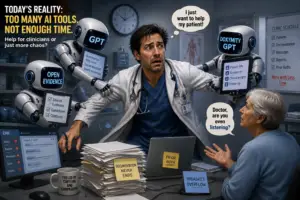
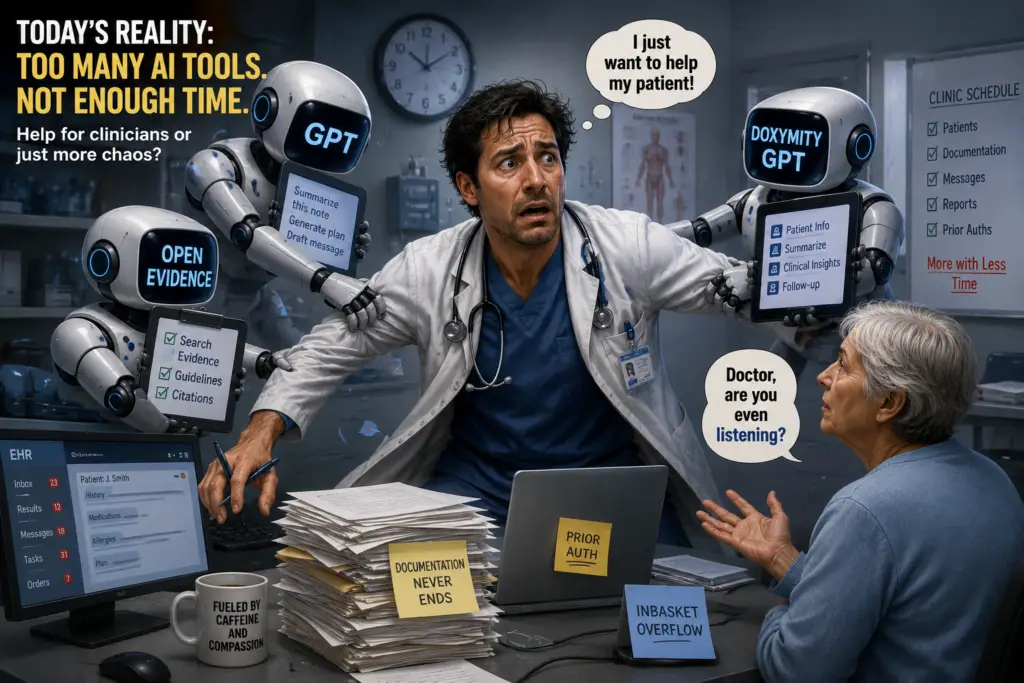
From planning an itinerary to writing meeting notes, cleaning up grainy photos, and drafting code, AI/LLM tools are quickly becoming utilities we can’t live without — right up there with coffee and Wi-Fi, and arguably more addictive than both.
Healthcare has historically been one of the slowest sectors to adopt new technology (England et al., 2000), but LLM adoption is upending that reputation. Ambient scribe systems, knowledge-based LLMs, and clinical decision support tools are already reshaping practice.
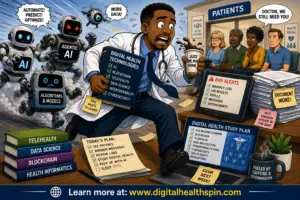
Most physicians already sense that AI/LLM is becoming the new stethoscope: a basic working understanding is no longer optional. Call it clinical Darwinism — adapt, or risk being left behind as the human-machine partnership becomes standard practice.
If you’re reading this, you’re already ahead of the curve. This guide shows you how to evaluate any introductory AI/LLM course, using the most visible options as a working example — not an endorsement. We have no financial ties to any course listed here.
AI/LLM tools are quickly becoming utilities we can't live without — right up there with coffee and Wi-Fi, and arguably more addictive than both.
Ahmed-Digital Doc Tweet
What Makes an AI in Healthcare Course Worth Your Time
The 13-Topic Curriculum Checklist for a Balanced AI Course
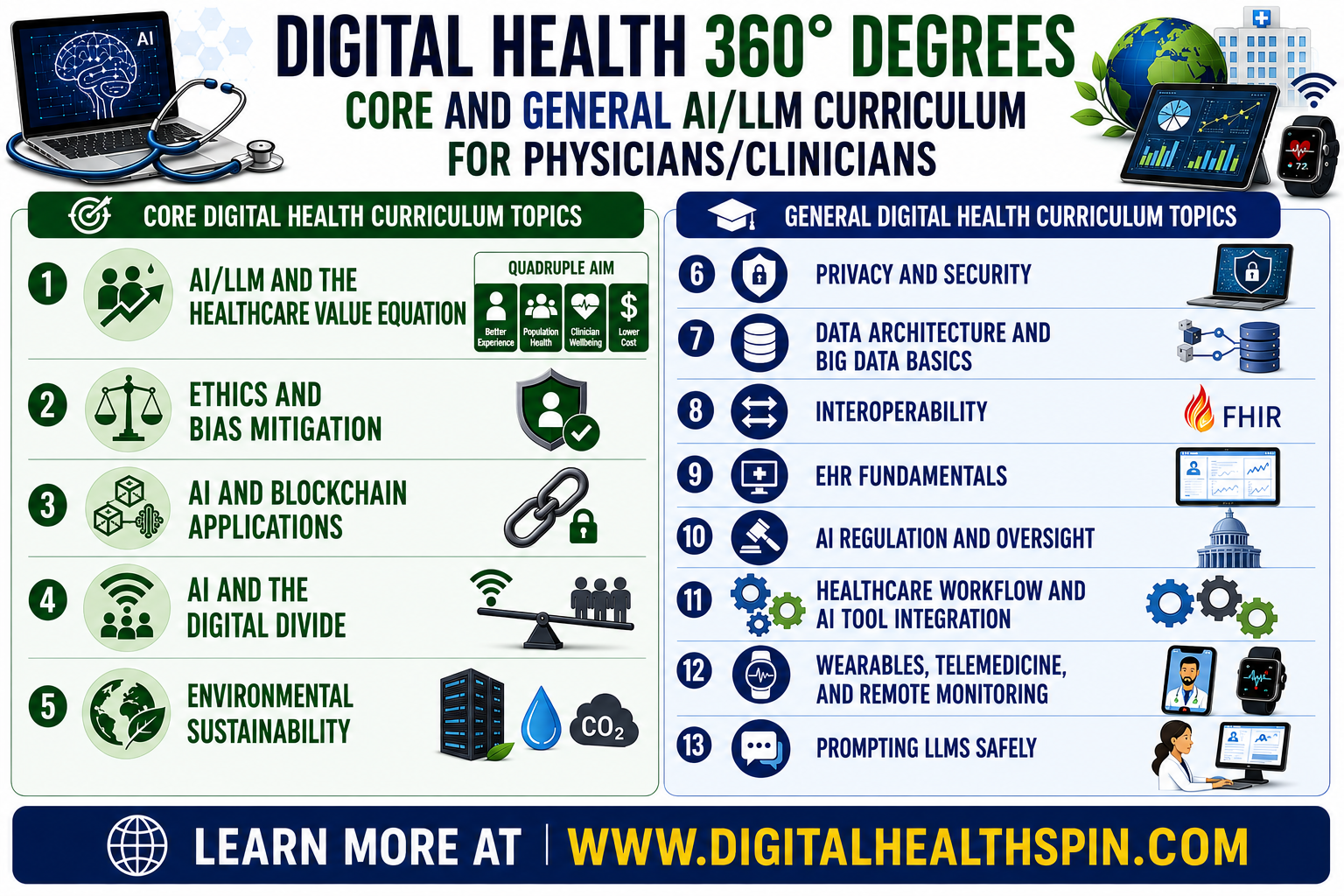
We identified 5 core and 8 general topics. A strong course should cover at least 3 of 5 core topics and 6 of 8 general topics — none of the popular courses we reviewed cleared that bar.
Core topics:
- AI/LLM and the healthcare value equation — AI has real potential to advance the Quadruple Aim: better experience, population health, clinician wellbeing, and lower cost (Weeks et al., 2024).
- Ethics and bias mitigation — AI isn’t perfect, and healthcare’s complexity makes instant ROI hard to achieve. See our related post on why.
- AI and blockchain applications — the synergy between AI and blockchain for data security and efficiency deserves a place in every introductory curriculum (Kasralikar et al., 2025).
- AI and the digital divide — broadband is now a “super” social determinant of health, and uneven AI access can widen existing disparities (Haider et al., 2024).
- Environmental sustainability — AI is energy-hungry, and data centers carry a real carbon and water cost that’s almost never taught (Purohit et al., 2022).
General topics:
- Privacy and security — hospital cyberattacks are surging (Offner et al., 2020), and AI systems are a new front door for data thieves; the only thing scarier than a ransomware note is getting one written in perfect, empathetic bedside manner.
- Data architecture and big data basics — data is AI’s foundation, so clinicians should understand how relational and big-data systems store patient information (El Aboudi & Benhlima, 2018).
- Interoperability — how data moves between systems through standards like FHIR (Vorisek et al., 2022).
- EHR fundamentals — the EHR is the “mother ship” for clinical data, quirks and all (Blumenthal, 2010).
- AI regulation and oversight — current frameworks are still catching up to the pace of AI deployment (Gerke et al., 2020).
- Healthcare workflow and AI tool integration — new tools must fit an already complex workflow, or they add work instead of removing it (Eikey et al., 2019).
- Wearables, telemedicine, and remote monitoring — proven to improve outcomes for select chronic conditions (Noah et al., 2018).
- Prompting LLMs safely — a well-built query is the difference between a useful answer and a dangerous one (Liu et al., 2025). Skipping this step is like handing a teenager the keys to a Ferrari without a driver’s license and pointing them at a race track.
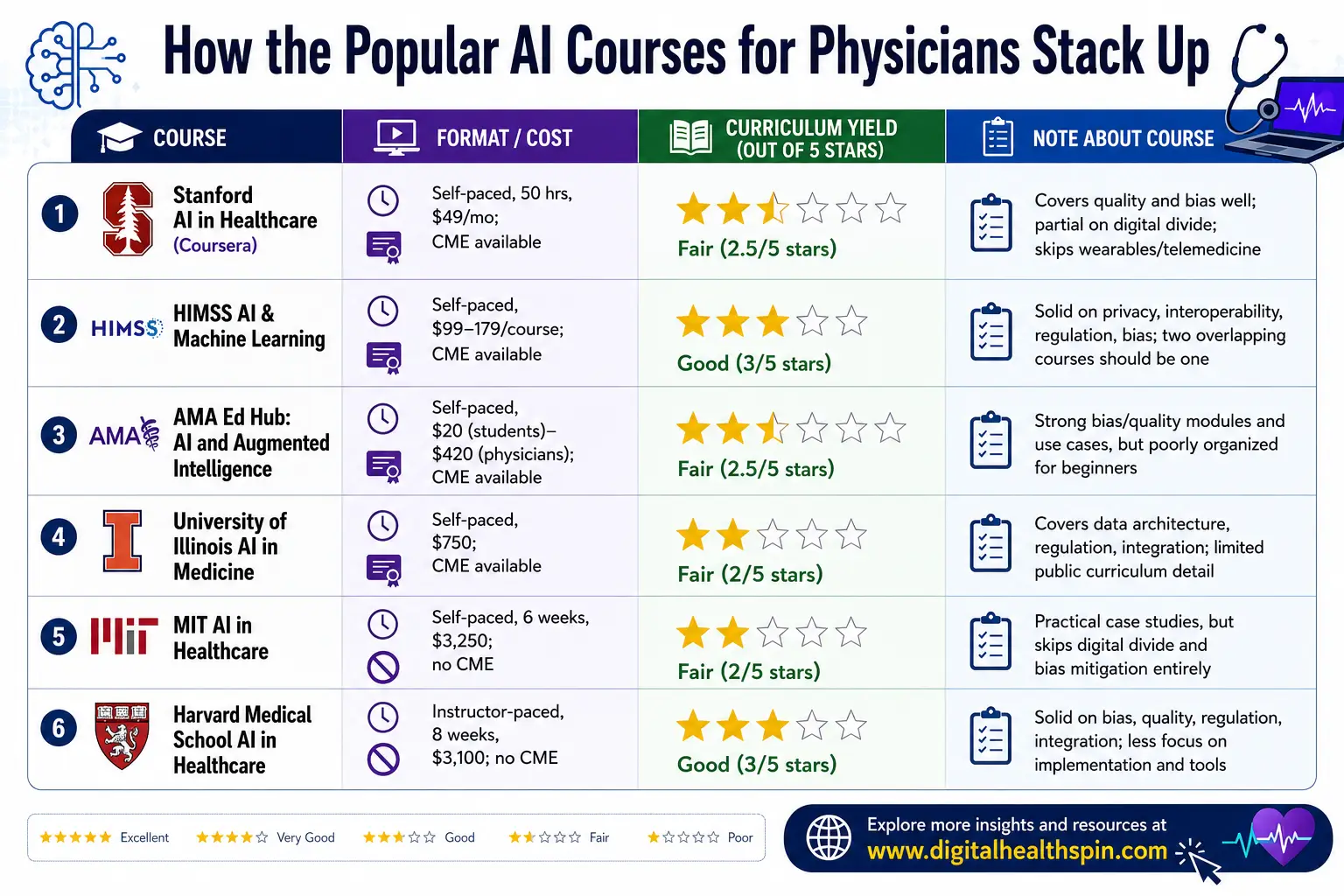
How the Popular AI Courses for Physicians Stack Up
A basic working understanding of AI/LLM is no longer optional. Call it clinical Darwinism — adapt, or risk being left behind as the human-machine partnership becomes standard practice
Ahmed-Digital Doc Tweet
Our Verdict: Digital health 360 degrees lens
None of the popular courses we evaluated had an excellent curriculum — fair-to-moderate was the ceiling. Only 3 of 6 offer confirmed CME (Stanford, AMA Ed Hub, University of Illinois); the two priciest, most prestigious options — MIT ($3,250) and Harvard ($3,100) — grant no CME at all.
Across the board, interoperability, AI-blockchain, wearables/remote monitoring, digital divide, LLM prompting, and environmental sustainability were consistently underserved. Our suggestion: combine two or three courses — the HIMSS, AMA Ed Hub, and Harvard offerings are a reasonable starting point, since they had the most balanced curricula of the six.
It’s worth remembering that AI/LLM is one tool in the digital health toolbox, not an oracle.
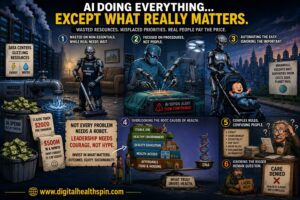
Beyond the hype that AI would replace oncologists, IBM’s Watson for Oncology fell well short of its promise (Schmidt, 2017), and radiologists remain in high demand despite years of “obsolescence” predictions (Jing et al., 2025). A balanced digital health curriculum — not AI alone — is what gets you through this fourth industrial revolution.
See our related previous post on Digital health curriculum for physicians here
If you’re a practicing physician with an NPI number, we’re happy to help you personalize your AI training curriculum. Email ahmed@digitalhealthspin.com with the subject “AI curriculum assistance.”
In Good Health,
The Digital Health 360° Framework™
Your guide to health innovation through:
- Clinical Value
• Health Equity
• Economic Sustainability
• Environmental Sustainability
References:
- Blumenthal, D. (2010). Launching HITECH. New England Journal of Medicine, 362(5), 382–385. https://doi.org/10.1056/NEJMp0912825
- Eikey, E. V., Chen, Y., & Zheng, K. (2019). Unintended adverse consequences of health IT implementation: Workflow issues and their cascading effects. In Cognitive Informatics (Springer).
- El Aboudi, N., & Benhlima, L. (2018). Big data management for healthcare systems: Architecture, requirements, and implementation. Advances in Bioinformatics, 2018, 4059018. https://doi.org/10.1155/2018/4059018
- England, I., Stewart, D., & Walker, S. (2000). Information technology adoption in health care: When organisations and technology collide. Australian Health Review, 23(3), 176–185. https://doi.org/10.1071/AH000176
- Gerke, S., Babic, B., Evgeniou, T., & Cohen, I. G. (2020). The need for a system view to regulate artificial intelligence/machine learning-based software as medical device. npj Digital Medicine, 3, 53. https://doi.org/10.1038/s41746-020-0262-2
- Haider, S. A., Borna, S., Gomez-Cabello, C. A., et al. (2024). The algorithmic divide: A systematic review on AI-driven racial disparities in healthcare. Journal of Racial and Ethnic Health Disparities. https://doi.org/10.1007/s40615-024-02237-0
- Jing, A. B., Garg, N., Zhang, J., & Brown, J. J. (2025). AI solutions to the radiology workforce shortage. npj Health Systems, 2, 20. https://doi.org/10.1038/s44401-025-00023-6
- Kasralikar, P., Polu, O. R., Chamarthi, B., et al. (2025). Blockchain for securing AI-driven healthcare systems: A systematic review and future research perspectives. Cureus, 17(4), e83136. https://doi.org/10.7759/cureus.83136
- Liu, J., Liu, F., Wang, C., & Liu, S. (2025). Prompt engineering in clinical practice: Tutorial for clinicians. Journal of Medical Internet Research, 27, e72644. https://doi.org/10.2196/72644
- Noah, B., Keller, M. S., Mosadeghi, S., et al. (2018). Impact of remote patient monitoring on clinical outcomes: An updated meta-analysis of randomized controlled trials. npj Digital Medicine, 1, 20172. https://doi.org/10.1038/s41746-017-0002-4
- Offner, K. L., Sitnikova, E., Joiner, K., & MacIntyre, C. R. (2020). Towards understanding cybersecurity capability in Australian healthcare organisations: A systematic review. Journal of Asian Public Policy, 15(2), 1–19. https://doi.org/10.1080/17516234.2020.1801353
- Purohit, S., Neve, R. D., Sundaramoorthy, K., et al. (2022). Assessing the carbon footprint of digital health interventions: A scoping review. Journal of the American Medical Informatics Association, 29(12), 2128–2139. https://doi.org/10.1093/jamia/ocac196
- Schmidt, C. (2017). M. D. Anderson breaks with IBM Watson, raising questions about artificial intelligence in oncology. JNCI: Journal of the National Cancer Institute, 109(5), djx113.
- Vorisek, C. N., Lehne, M., Klopfenstein, S. A. I., et al. (2022). Fast Healthcare Interoperability Resources (FHIR) for interoperability in health research: Systematic review. JMIR Medical Informatics, 10(7), e35724. https://doi.org/10.2196/35724
- Weeks, W. B., Lavista Ferres, J. M., & Weinstein, J. N. (2024). Artificial intelligence: Promise and peril in achieving the quadruple aim in healthcare. Frontiers in Artificial Intelligence, 7, 1430756. https://doi.org/10.3389/frai.2024.1430756
Courses reviewed:
Stanford AI in Healthcare Specialization. Coursera.
HIMSS AI and Machine Learning Course. HIMSS.
AMA Ed Hub: Artificial and Augmented Intelligence in Health Care. American Medical Association.
University of Illinois AI in Medicine Certificate. Carle Illinois College of Medicine.
MIT AI in Healthcare. MIT Executive Education.
Harvard Medical School AI in Health Care: From Strategies to Implementation